2 minute readNewAgent-ready
See the real price behind a deal
A price check from a photo, listing, screenshot or description now reads what the seller claims to make the price look good, and shows what one unit really costs once the deal is taken.
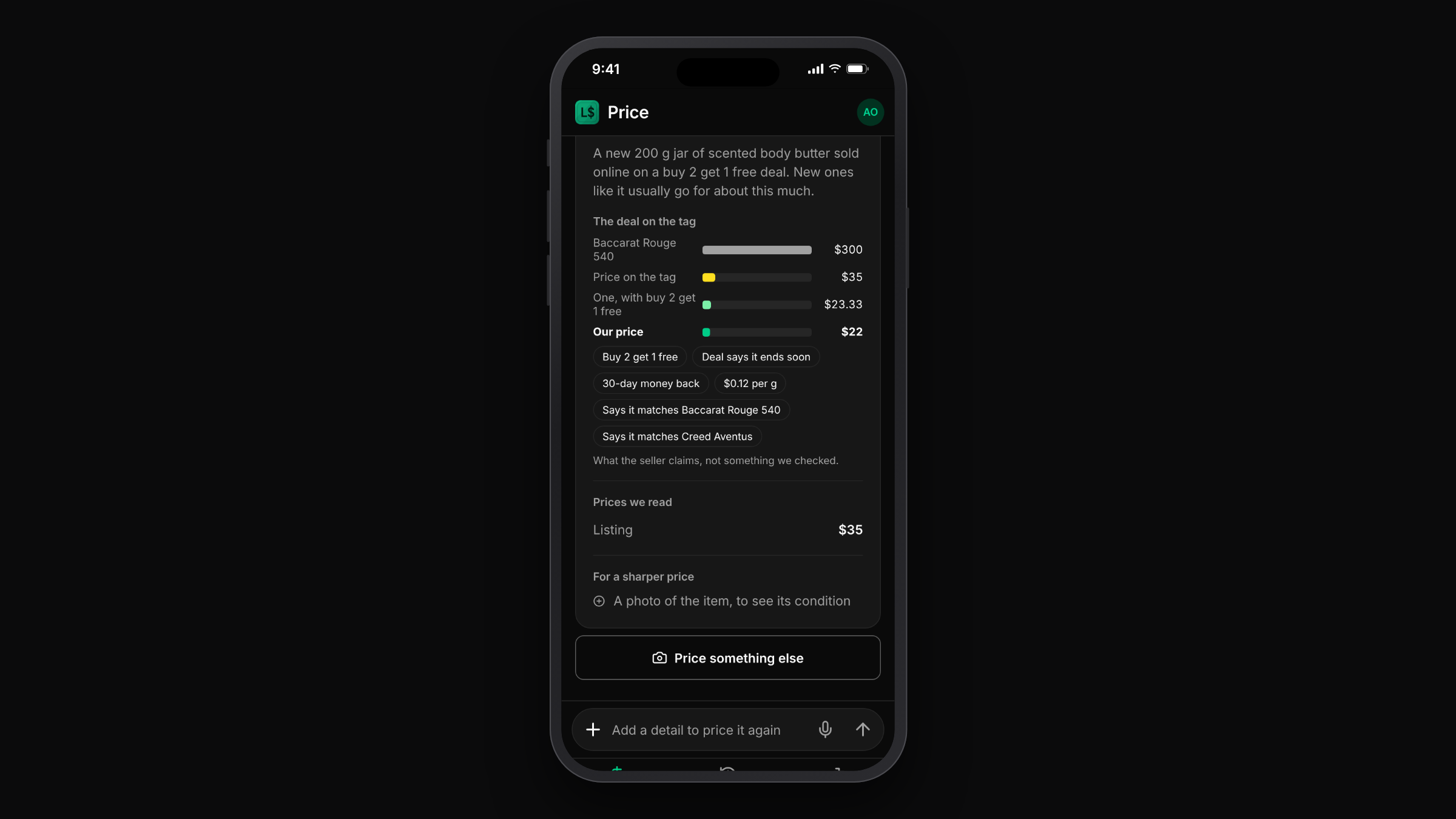
A tag, listing or ad often argues for its own price: "same oils as Baccarat Rouge 540", buy 2 get 1 free, "ends today". A price check now reads those claims and works out the price underneath them. In the mobile app the result card shows them in a new block, "The deal on the tag".
- What it reads. A named product the seller says it matches or copies (a "dupe") with that product's usual price, a multi-buy deal, a deadline, a money-back guarantee such as 30 days, and the pack size, for example 200 g.
- One unit with the deal. A $35 jar on buy 2 get 1 free came to $23.33 each. The check also gave the price per gram, ml or oz, for example "$0.12 per g".
- Bars on one scale. The block draws the claimed product's price ($300), the price on the tag ($35), one unit with the deal ($23.33) and our price ($22), so the gaps are plain to see.
- Chips. Under the bars: "Buy 2 get 1 free", "Deal says it ends soon", "30-day money back", "$0.12 per g", "Says it matches Baccarat Rouge 540" and "Says it matches Creed Aventus". The caption reads "What the seller claims, not something we checked."
- For agents.
price_from_captureand POST /api/price-router/pipelines return the same claims asvaluation.seller_claims: each named product with its claim, price and ratio, plus the deal, deadline, guarantee, size, shown price, unit price with the deal and price per unit of size. It is left out when the attachments make no such claim, and it never fails a price.