Webhooks
Subscribe to every metering and settlement event.
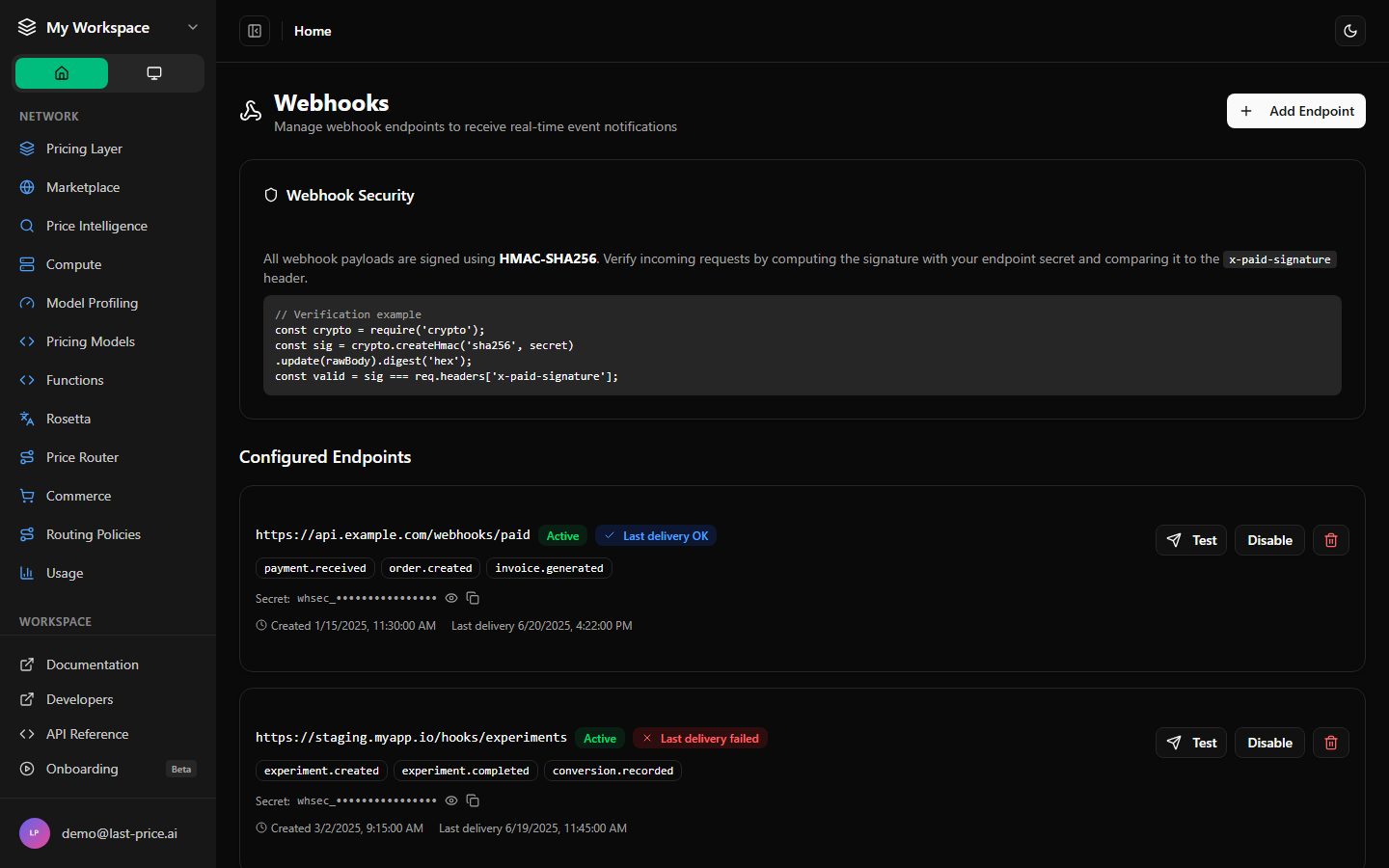
Last Price emits HMAC-SHA256 signed webhooks for every meaningful platform event. Verify the x-lastprice-signature header against the raw body and you can trust the payload end-to-end.
What you can do
- Subscribe any HTTPS endpoint with a per-destination signing secret.
- Verify each request with HMAC-SHA256 over the raw body, header is x-lastprice-signature (the older x-paid-signature carries the same value).
- Filter by event type, function, or tenant when you only care about a subset.
- Inspect every delivery: request body, response status, retries, and timing.
- Automatic retry with exponential backoff on 5xx and network errors.
Event types
compute.completedA pricing call ran. Includes the metering breakdown.
compute.failedA pricing call failed. Includes the routed function and error.
signal.createdA new anomaly signal was detected.
invoice.createdA new invoice is ready for the tenant.
invoice.paidA tenant paid an invoice.
dispute.openedA dispute was opened against a compute charge.
function.publishedA function was published or updated in the marketplace.
platform.changelogA changelog entry for agents was published. Carries the new entries and the feed address. Sent only to endpoints that subscribe to it by name.
balance.lowA compute call took the prepaid balance below the auto top-up threshold you set. Carries the balance and the top-up request. Nothing is charged.
usage.outcome_recordedYou reported whether a price was used. With outcome pricing on, says what was refunded.
outcome.settledAn outcome pricing window was decided: by your report, or as accepted when it closed with none.
Verify a delivery
import crypto from "node:crypto"

export function verifyWebhook(rawBody: string, header: string, secret: string) {
  const expected = crypto
    .createHmac("sha256", secret)
    .update(rawBody)
    .digest("hex")
  // Constant-time compare to avoid timing leaks.
  const a = Buffer.from(expected, "hex")
  const b = Buffer.from(header, "hex")
  return a.length === b.length && crypto.timingSafeEqual(a, b)
}

// In your route handler:
const ok = verifyWebhook(rawBody, req.headers["x-lastprice-signature"], process.env.WEBHOOK_SECRET)
The signature is HMAC-SHA256 over the raw request body, not the parsed JSON, and no timestamp. Use a constant-time compare to avoid timing attacks. See packages/security/webhook.ts for the canonical implementation.
Ready to try it?
Spin up a free playground tenant in under a minute. No credit card.